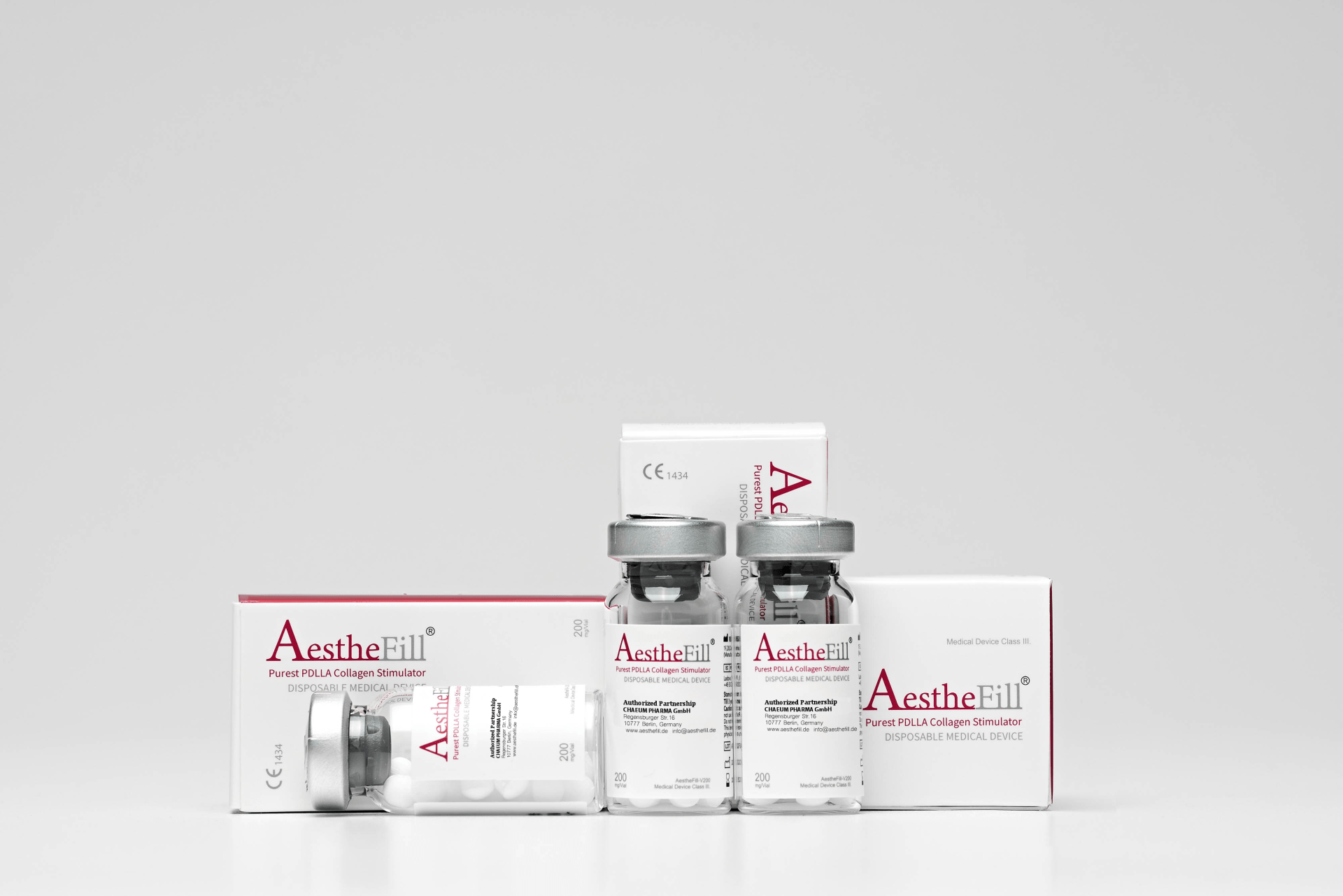
AestheFill V200 – 1 x 200mg
$ 93.79

secure Polylactic acid is approved by the FDA and has been registered as GRA (Generally Recognized as Safe) since 1984. AestheFill® has received more than 20 conformities, so-called “compliances”, worldwide, thus proving its safety many times over. Biocompatible In the last ten years of use, neither allergic reactions nor rejection symptoms have occurred, which proves that it is an excellent solution for correcting wrinkles and lines on the face and body shape. Biodegradable During the stimulation phases following the injection, collagen and PDLLA are completely absorbed and broken down by the human body over a period of 24 months. Natural volume The focus of PDLLA is on a slow release of the effect over a period of about 24 months. This ensures a natural appearance in all intended application areas. Pleasant procedure No cuts, no bleeding, fewer complications. A simple injection leads to a truly relaxing experience. A pleasant procedure that leads to the highest level of patient satisfaction. Comfortable application The technical feature enables a generally simple application process. Dissolving in sterile water (injection water) takes only a few minutes, making an uncomplicated injection and follow-up treatment possible. Main component: PDLLA (Poly-D,L-lactic acid) PDLLA (Poly-D,L-lactic acid) is an aliphatic thermoplastic polymer derived from 100% renewable raw materials, i.e. corn and potato starch. It is widely used in the medical industry (injectables, biodegradable dental implants and sustained-release drugs) and offers a high level of safety. Lactic acid consists of two optical isomers, L-lactic acid and D-lactic acid, both of which have the same chemical and physical properties. PDLLA is formed by polymerization. Optical isomers: have the same molecular formula but a different arrangement of atoms. Optical isomers The development of PDLLA began in 2003 as part of a Korean government project involving six national universities, including KAIST, the most prominent scientific university in Korea. An extensive eight-year development and clinical study was conducted under the supervision and reporting of the Ministry of Economy and Science. ref.2011.10 Hyper-Extension of adaptable human tissue engineering on bio molecular science for cell-reconstruction. Structure and organization Security features AestheFill® uses FDA-approved GRAS (Generally Recognized as Safe) substances, which underpins its safety and quality. More than 20 countries worldwide continuously monitor and confirm this safety. Our unique manufacturing process and biocompatible polymer make AestheFill® the first choice for applications to reduce wrinkles and improve body contours, with little to no side effects or allergic reactions. Biodegradable: Through hydrolysis, PDLLA is broken down into CO2 and H2O and excreted outside the body. The polylactic acid distributes very well on site, without allocations after injection into the surrounding tissue. compared to conventional fillers Traditional Fillers Other polymer fillers material PDLLA (Poly-D, L-lactic acid) Hyaluronic acid PCL (PDO) How it works Improvement of wrinkles, skin structure and skin shine through collagen stimulation immediate effect immediate effect Results Result in 3-8 weeks immediate, but decreasing over time Volume loss over time Duration of effect 20-24 months 3-6 months 6-9 months Advantages Does not migrate immediate effect no massage required long-term natural effect no burning during injection low risk of intravascular occlusion –Possible migration –Can attract water and swell –Risk of intravascular occlusion –Possible side effects after treatment –Possible migration –Risk of intravascular occlusion –burning sensation during injection –Reports of allergies and inflammation AestheFill®, an injectable polylactic acid (here even PDLLA), is a pioneer in aesthetic medicine and sets the highest standards in biotechnology. It is a biocompatible, biodegradable, biostimulating and long-lasting substance that ushers in a new era of collagen stimulation, with the added convenience of a simple reconstitution step before application. Clinical results show an improvement in volume and texture over 20, maximum 24 months. Injectable poly-D,L-lactic acid for facial rejuvenation: three case reports. Jui-Yu Lin and Chuan-Yuan Lin. Cosmetol J 2020, 4(1):000120. What is AestheFill®? AestheFill® is a further development of polylactic acid as poly “di” lactic acid -PDLLA (poly-D, L-lactic acid) and is a polymerized optical isomer for injection into the skin. A Class III medical device for use on the entire facial area to improve skin quality, texture and wrinkles. The effect lasts for approximately 24-36 months because Aesthefill has the natural effect of stimulating collagen. *AestheFill® Clinical Study Report_2014-2022. How does AestheFill® work? The natural result of AestheFill® becomes apparent gradually over a period of up to 24-36 months. It helps to regenerate and stimulate the body’s own collagen, which contributes to a voluminous and fresh appearance with a long-lasting result. How does AestheFill® work? Apart from the immediate effects that can be seen immediately after application and after reconstitution with sterile water, the regeneration and stimulation of collagen takes some time. The time period may vary according to the individual patient’s condition, but on average, noticeable results, such as improved skin texture, can be seen within 5 to 10 days once stimulation begins in the treatment area. The regeneration process continues over the next few weeks and reaches its expected and best result around 3 months after treatment. This sustained action improves skin turgor and skin texture itself, reduces wrinkles and leads to results that can last for two years or even longer. Where can I learn more about AestheFill®? AestheFill® is only used by accredited and trained doctors. They are trained and certified worldwide by the AestheFill® Academy in various categories and for various indications. Visit our website www.aesthefill.de and sign up for current information such as regional workshops in your area, conference information, latest news, clinical updates and magazines. Who can be treated with AestheFill®? This recommendation is based on our clinical data collected over 20 years from patients who wanted a long-lasting and natural result. The treatment is very effective for all age groups and good for better stimulation of collagen. The younger the patient, the more effective the treatment. *average treatment group of 20-70 years How many sessions are required? To achieve optimal results, a full treatment of 3 sessions is recommended. It can be extended or shortened depending on the patient’s condition. The interval between sessions should be 4-6 weeks. When was AestheFill® first approved commercially? In 2014, AestheFill® received its first KFDA approval, marking its official launch in the South Korean market. Since then, it has acquired compliance in over 50 countries worldwide, including CE (EC), ANVISA, INVIMA and GOST-R. Why AestheFill®? Challenges are also a driving force. We are constantly looking for them on the global market and are in constant communication with our partners to perfect well-established solutions and to develop new approaches. PLLA (polylactic acid) technology has been present on the medical market for more than 50 years, and here tried and tested methods meet innovation and challenges. Our solution offers a unique biotechnology that converts PLLA (polylactic acid) into PDLLA (poly-D, L-lactic acid). Based on our pure technology of patented BPM (biodegradable polymer microparticles), post-polymerization treatments. How it works 1. Instant volumizing effect directly after application 2. Biostimulation: Stimulation of new tissue and collagen production. Monocyte migration in the treatment area Production of new tissue, which is confirmed in histological analysis. Pink: cytoplasm Dark pink and blue: cell nucleus Arrows: foreign body giant cell Two weeks after application, cells grew and settled on the surface of the PDLLA particles and in the spaces between the particles. The empty spaces between the particles were filled with cells. After 8 weeks, there are no more empty spaces between the PDLLA particles because they are filled with cells that start to migrate into the porous PDLLA particles (yellow arrow). After 12 and 20 weeks, the cells have migrated into the interior of the PDLLA particles; they now fill the interior and the spaces between the particles. Histological analysis – IHC staining for actin and collagen type 1 Production of new tissue, which is confirmed in histological analysis. From week 4 onwards, new collagen was produced by the cells located in the PDLLA. After weeks 12 and 20, collagen expression increased between the porous PDLLA particles and within the particles (yellow arrows).